

Aktualności
Open TASQ seminar: March 27.
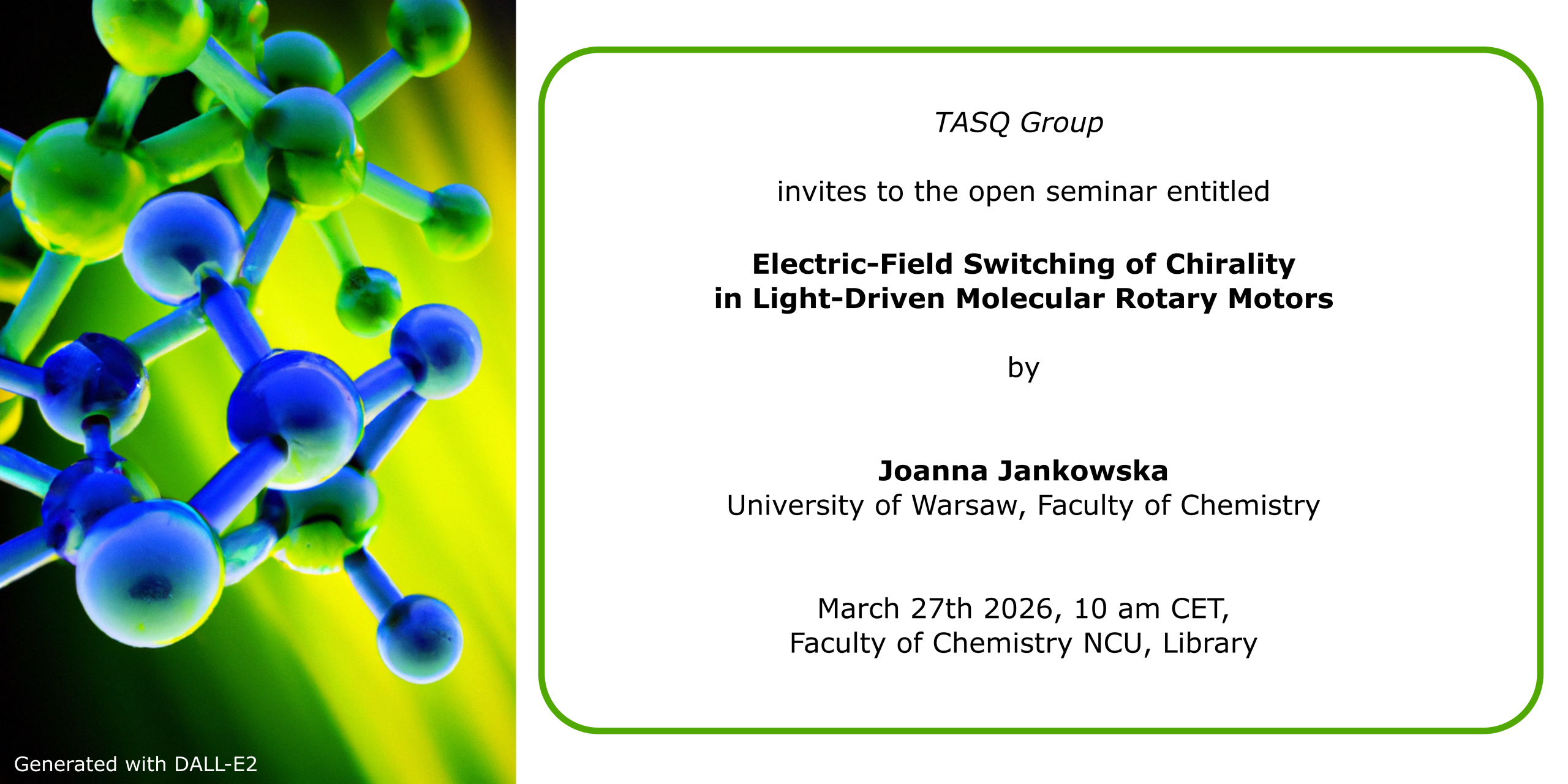
Joanna Jankowska from University of Warsaw will be the speaker on the TASQ seminar in March. The title of her talk is:
Electric-Field Switching of Chirality in Light-Driven Molecular Rotary Motors.
Light-driven rotary motors allow direct transformation of light energy into unidirectional rotary motion at the nanoscale, giving rise to countless emerging applications in molecular engineering. The key feature enabling the unidirectional rotation and controlling its direction is the motor chirality, an inherently chemical factor, hard to modify postsynthetically.
TASQ Seminar in February: Johannes Gierschner
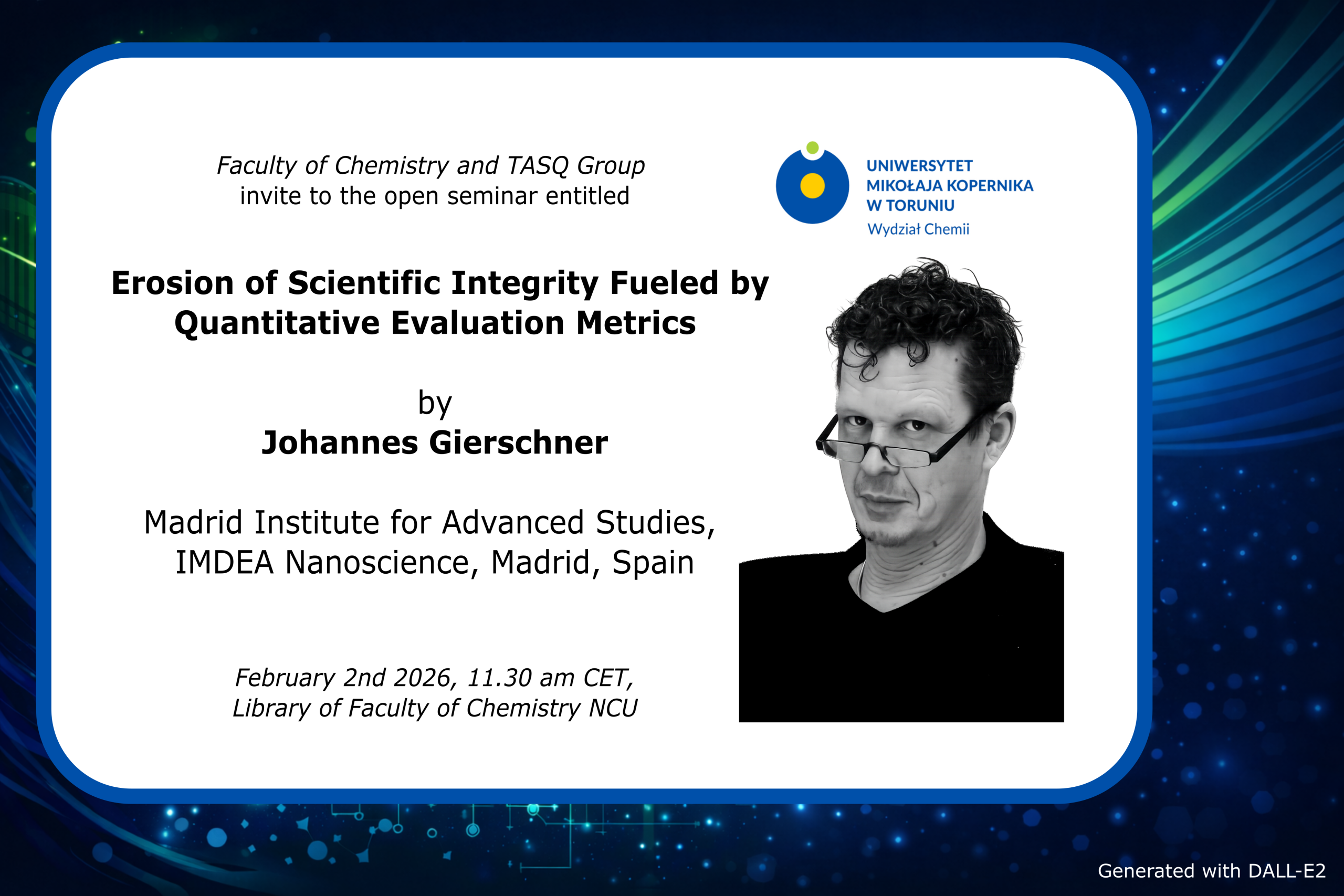
Johannes Gierschner from Madrid Institute for Advanced Studies, IMDEA Nanoscience will be our guest on Monday, February 2nd. He will give two talks:
- Emission Color Pureness and Efficiency Regulation in Organic Chromophores (abstract)
- Erosion of Scientific Integrity Fueled by Quantitative Evaluation Metrics (abstract)
Otwarte seminarium grupy TASQ
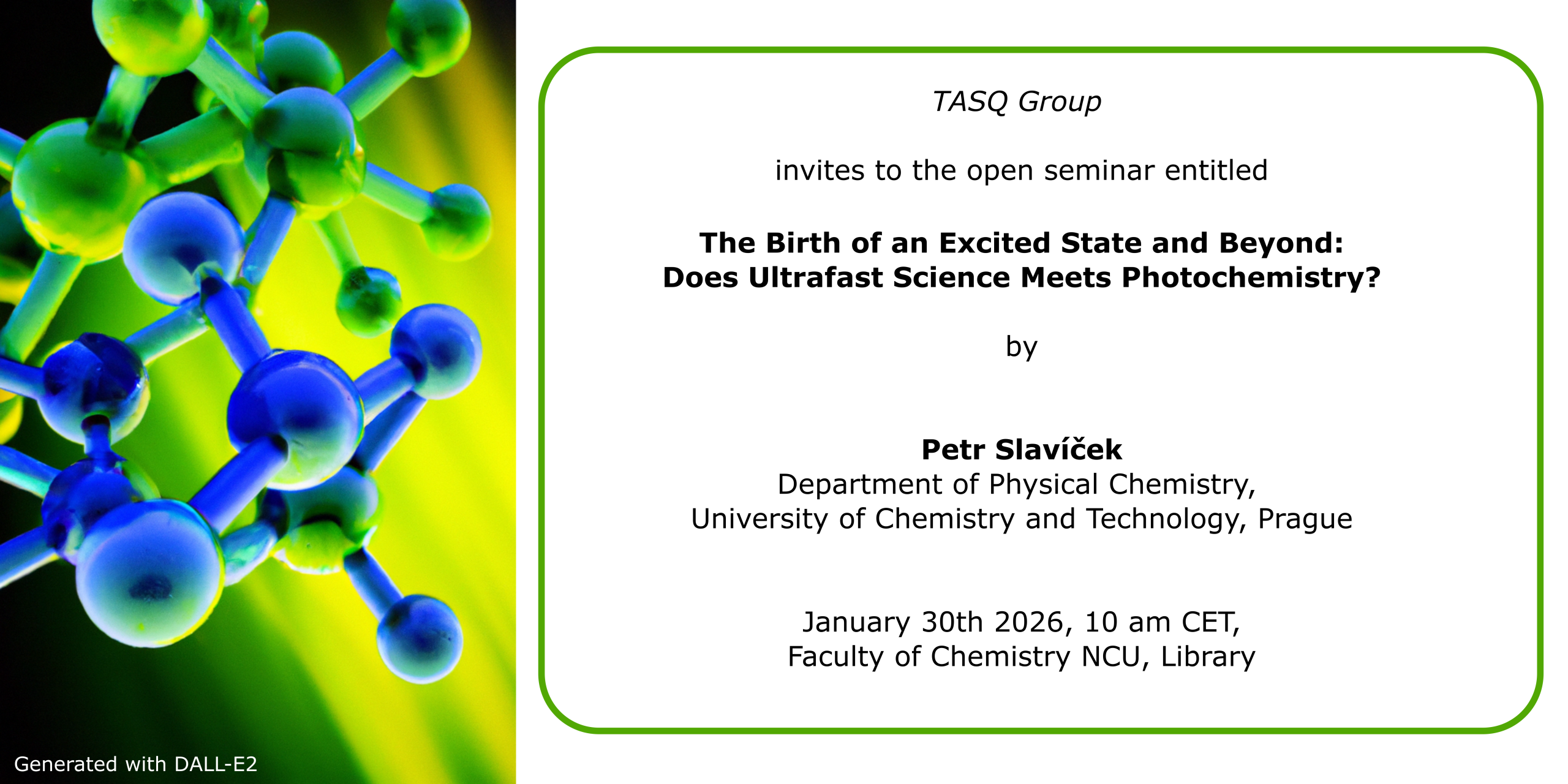
Petr Slavicek from Department of Physical Chemistry, University of Chemistry and Technology, Prague will give a talk entitled:
The Birth of an Excited State and Beyond: Does Ultrafast Science Meets Photochemistry?
In the abstract of the talk Petr writes:
Short laser pulses undeniably gave traditional chemical concepts new physical content, most famously by direct observation of atomic motion during chemical reactions. Do even shorter, brighter, and more energetic photons deliver a similar promise for photochemistry? Ultrafast X-ray sources now provide new windows on electronic structure, element specificity, and local environments and attosecond HHG pulses can in principle track the electronic motion. Yet it is not obvious that the resulting observables automatically translate into traditional chemical concepts. For example, organic chemists speak about electron flow, in ultrafast physics the same phrase can refer to something rather different. In that sense, the question behind this talk is: does ultrafast science meet (photo)chemistry?
Sympozjum „Interactions”
W piątek 28 listopada o godz. 14:30 w Instytucie Fizyki UMK rozpocznie się dwudniowe sympozjum „Interactions” poświęcone zagadnieniom związanym z oddziaływaniami międzycząsteczkowymi – od astrochemii, przez ultrazimne gazy atomowe, aż po zastosowania w katalizie chemicznej.
Otwarte seminarium grupy TASQ
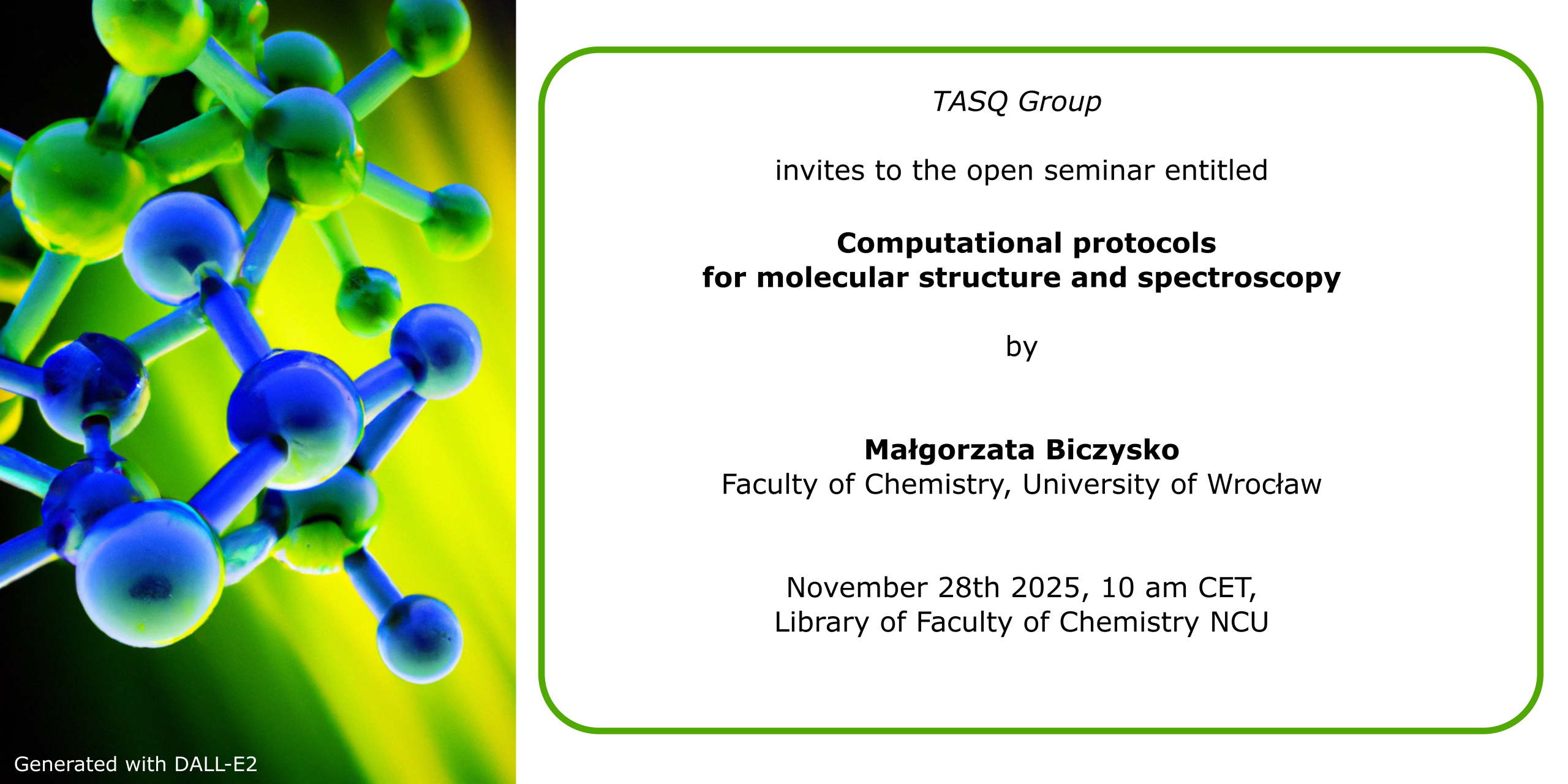 Gościem na seminarium TASQ będzie prof. Małgorzata Biczysko z Uniwersytetu Wrocławskiego – 28. listopada 2025, godz. 10:00; Biblioteka Wydziału Chemii
Abstract (pdf, 260 KB)
Molecular Excited States (MolEx) Workshop: 09/06/2025-13/06/2025
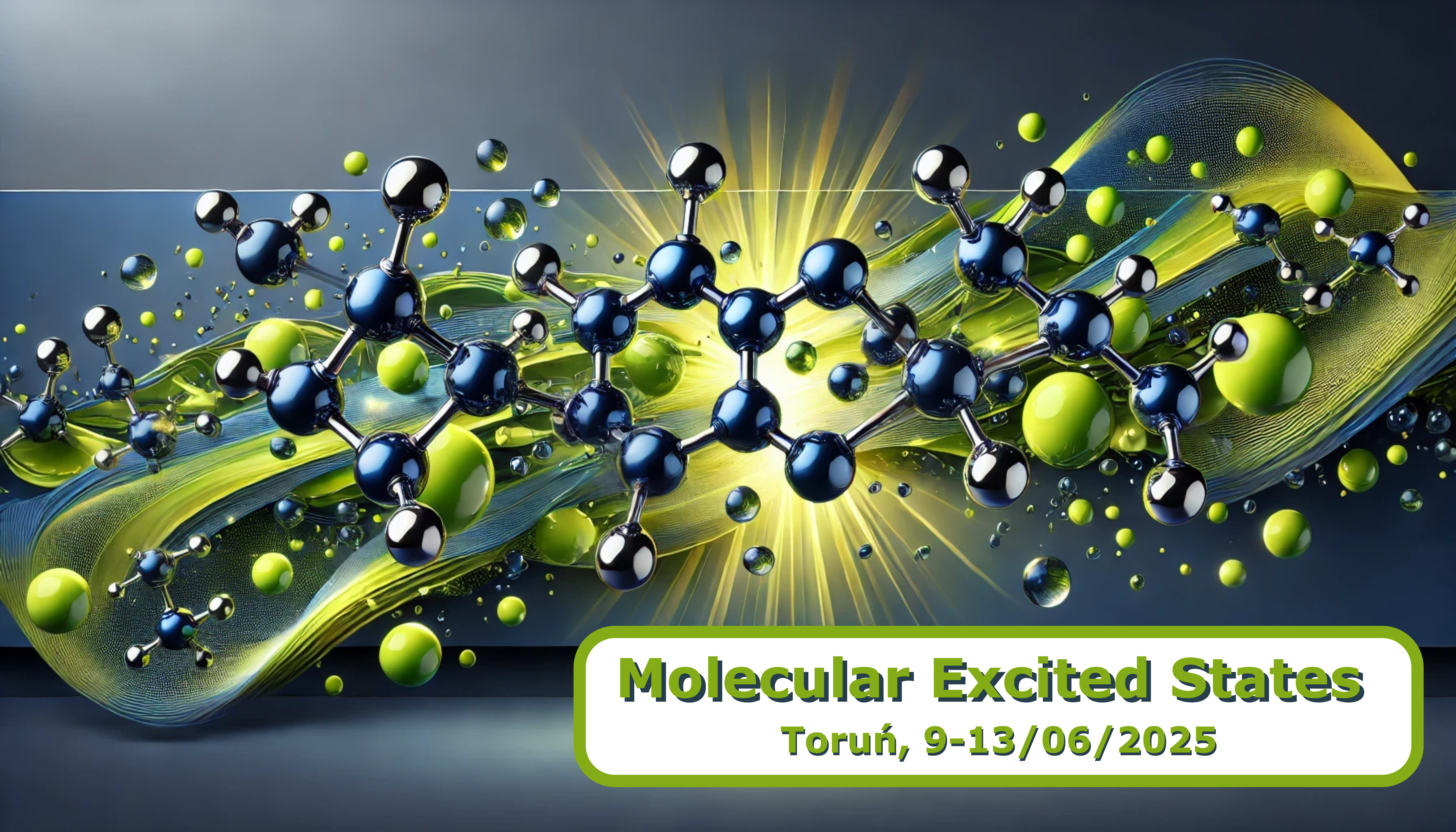
Growing interest in the developments of the devices and techniques using light for the biomedical and technological applications such as photovoltaics, OLED, photodynamic therapy or bioimaging requires the precise control of the photophysical behaviour of the molecular components of these systems and the abilities to predict the pathways of photochemical reactions. Thus, the MolEx workshop is devoted to the theoretical modeling of the excited states of chemical molecules. It aims in providing a vivid picture of the available approaches and tools for the description of the photophysical and photochemical processes starting from the high-level static ab initio calculations via the molecular dynamics simulations in excited state to the application of machine-learning tools for acceleration of the simulations.
https://molex.umk.pl/pages/home/
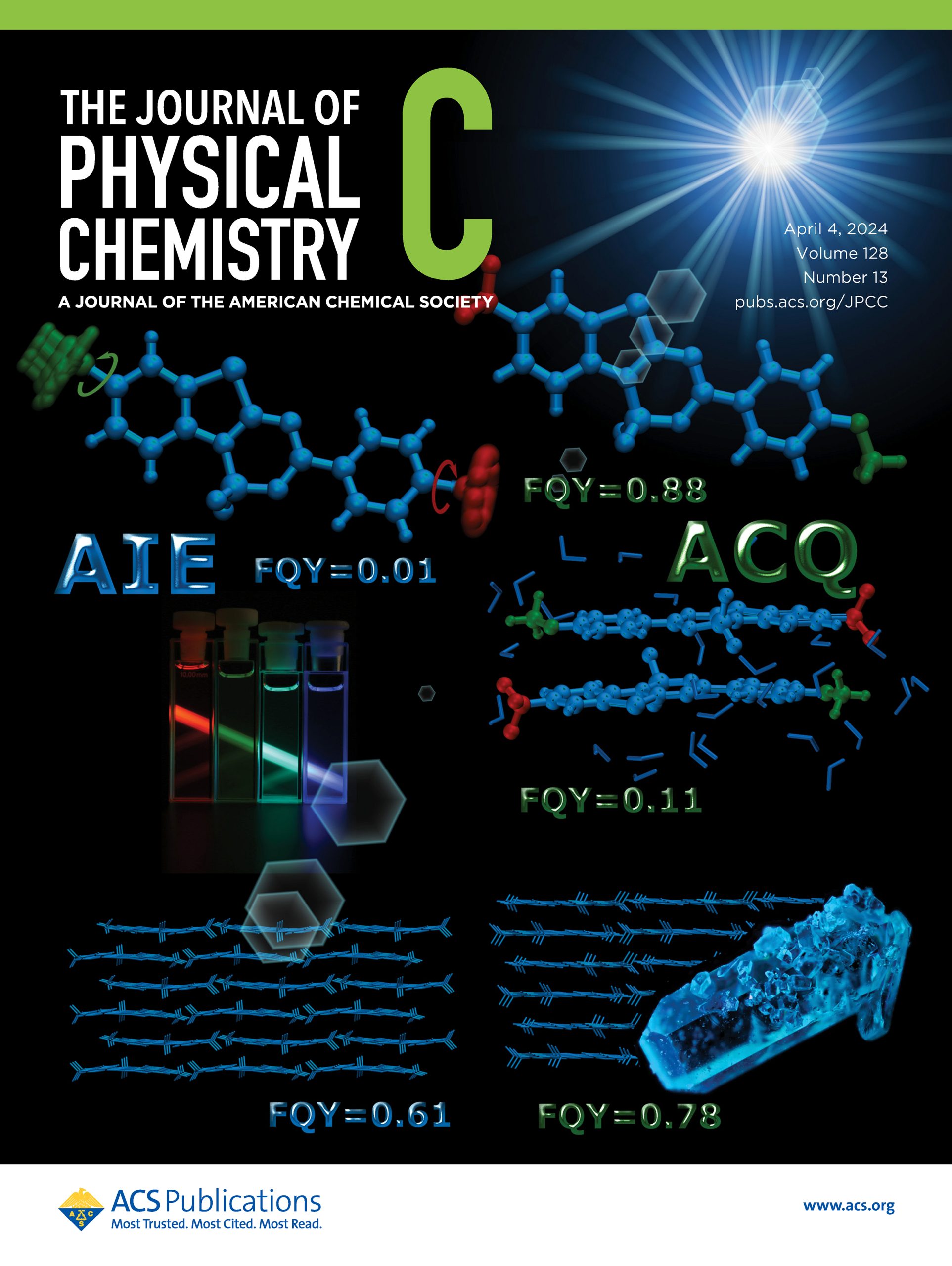 Praca Patryka Rybczyńskiego pt. „Topology Switch between AIE and ACQ: A Balance of Substituents” została wyróżniona okładką w The Journal of Physical Chemistry C.
J. Phys. Chem. C 2024, 128, 5651
https://doi.org/10.1021/acs.jpcc.4c00423
PYBEST v1.3.2 has been released!
PYBEST is a Pythonic Black-box Electronic Structure Tool, written primarily in the Python programming language with additional parts written in C++ and interfaced using pybind11.
More info available in:
PyBEST: Improved functionality and enhanced performance
K.Boguslawski, F. Brzęk, R. Chakraborty, K. Cieślak, S. Jahani, A. Leszczyk, A. Nowak, E. Sujkowski, J. Świerczyński, S. Ahmadkhani, D. Kędziera, M. H. Kriebel, P. S. Żuchowski, P. Tecmer
Computer Phys. Commun. 2024, 297, 109049
https://doi.org/10.1016/j.cpc.2023.109049
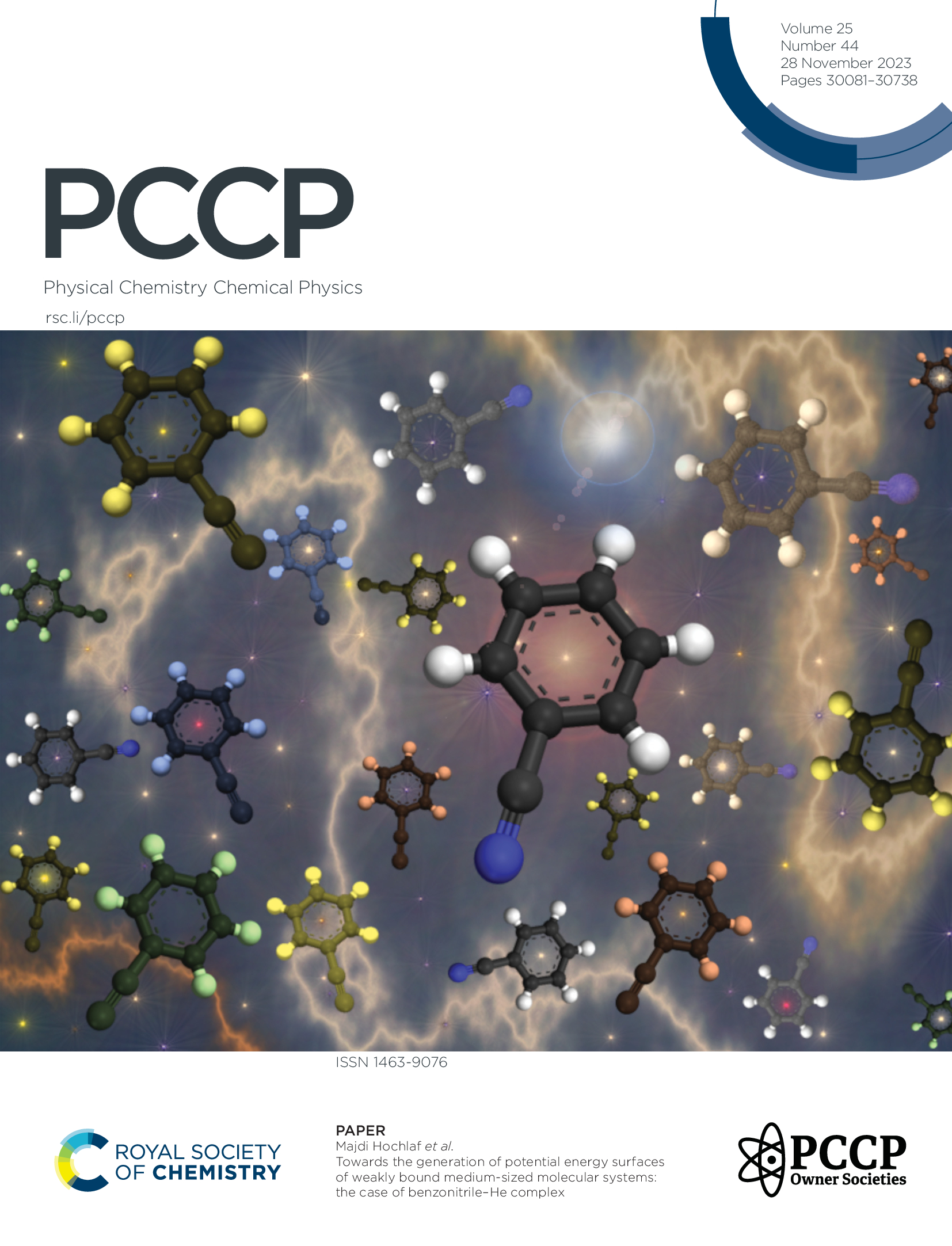
Publikacja dr. Dariusza Kędziery i współpracowników, zatytułowana „Towards the generation of potential energy surfaces of weakly bound medium-sized molecular systems: the case of benzonitrile–He complex”, została wyróżniona okładką listopadowego wydania czasopisma Physical Chemistry Chemical Physics.
Phys. Chem. Chem. Phys., 2023,25, 30198-30210 DOI: https://doi.org/10.1039/D3CP02720A